Showing posts with label self sufficiency. Show all posts

Wednesday, April 11, 2018

Farm Skills - a post written last year and then never published

We never set out to live as we do. It just happened. Each day presents its own opportunities for discovery and experience, exploration and adventure. Some we grasp eagerly and others slip by unnoticed.

Today my family is immersed in the music and lyrics of Sweeney Todd, a musical we saw when on holiday in Cape Town. The songs are playing, full volume, while dinner preparation is underway.

Yesterday I hand spun dog hair on the spindle that Decadent Dad turned on the lathe a while back. I spun it on a whim, just to see if I could. The Siberian Husky hair makes a delightfully soft yarn.


Since living on this farm in the Free State I have learned to:

make yoghurt, butter, cheese, and to milk a cow

ride a horse

raise heirloom vegetables from seed

grow enough vegetables to feed my family for a year

crochet well enough to make blankets for my children

raise orphan lambs

spin my hand-raised sheep, Lucy's wool

spin alpaca fibre into luxurious yarn

quilt with the help of a delightful quilt group

raise chickens, calves, pigs and sheep

help a cow with a difficult calf delivery

administer injections to our animals

make apple cider and apple cider vinegar

render lard

make delicious guinea fowl pie

make do without clean water in our taps for extended periods

gather beeswax for soap making

preserve almost every kind of local fruit and vegetable

grow and grind our own maize for porridge, bread and tortillas

sing worship songs in seSotho


brew herbal teas

dry fruit from the summer harvest


Each new skill presented itself as a natural response to a need, opportunity or responsibility. My teachers have been books, wonderful people, my animals and the internet. Some lessons grew out of my dislike of waste and the satisfaction I feel from using my resources to their capacity. I am eager to learn so much more.

I would love to:

begin exploring the art of using natural dyes for fleece

 try a little more felting

learn to embroider beautifully

weave some of my handspan yarn

learn to weave the thatching grasses into broom, baskets and hats

learn to speak seSotho so that I can engage with the farm women and children

teach the little ones some arts and crafts

ride better than I do

grow disease-free tomatoes successfully

plant a prettier garden

write

paint

make fruit wine

and so much more....

Friday, November 18, 2016

Making Do in Abundance

WARNING... the longer I wait between posts, the longer my posts become. (This one was written 2 weeks ago, but I am only uploading pics and posting today.)

I have gone from someone who blogged about twice a week to someone who may blog every two months. I love writing and often find myself composing blog posts in my head, but seldom find the time to sit and type them up. My interests and crafting activities have developed and expanded so that could be a reason. I seem to live in seasons. I really really do want to continue blogging as my heart is to keep a literal web log of my life here on this farm and there is so much to record and share.
So thank you, Cindy, for the reminder to keep on writing. Ideally I would like to write frequent, short posts.

It is a sultry Friday afternoon. My son has just dragged himself back to his desk to study. He wrote a 3 hour Maths paper this morning. I am sitting at my desk with the curtains drawn in an attempt to keep cool. It's too hot to wear shoes, so I have kicked them off. I am rolling my feet over wooden beads as I type.

I had planned to wash some fleece this afternoon, but we have no clean water in our tank again. We are piping river water into the house so that we can still shower and flush, but Caledon River water is silty so it won't help to clean fleeces.

Next on the To-Do list was to make a batch of soap. Washing soapy pots and utensils uses a fair bit of water and when we are heating pots of clean water on the stove for each load of dishes...

It's too hot to spin, weave, cook or garden.

So I have no excuse not to write.

October has been a financially challenging month. We were recovering from September: We celebrated my husband's 50th and our daughter's 21st birthdays which also required a road trip to Cape Town. We discovered that a lot of my husband's tools that he uses for work have been 'taken'. Our vehicle needed major repairs and we had to pay a lump sum for education fees. In order to ease things I have shopped as little as possible. In fact I spent less on groceries for the month than someone I know spent on one meal for a braai (barbecue).

How did I do it?

Firstly, we use what there is in the house instead of rushing off to the shops. The best way of saving money is not to spend it. Usually my two guys have no idea that I am hustling to stretch our resources as they are always well fed and they don't feel deprived. That's the key to being Elastic Mom.

And October is strawberry month.


When we ran out of dishwasher blocks, we only washed the dishes by hand for the rest of the month. (Although in desperation Decadent Dad did try to run the dishwasher using dish liquid.) I haven't felt the need to buy more dishwasher blocks yet. I quite enjoy the contemplation of washing dishes and looking at the view.

I drink decaf coffee, so when that ran out I drank more tea and switched to the occasional cup of cocoa topped with leftover party marshmallows. It's all about using what there is, rather than what we might want, but making it good and tasty.

When the milk ran out, we drank interesting black, herbal tea or iced tea. I made rooibos and lemon verbena tea, mint and sage exam time tea, mint and fennel digestive tea.

When the teabags ran out we drank iced water, herbal teas and strawberry smoothies, and by then we had bought some lovely Jersey milk from my friend so Decadent Dad could make himself some coffee again. We did also buy some milk. We haven't replaced the decaf, but I don't miss it yet.

We are blessed with a freezer full of our own pasture raised beef and pork. So that is what we ate. I didn't buy any fish, lamb or chicken. I would ring the changes with vegetarian meals too. We have some of our own cheese,  and always one or two eggs in daily supply. Some days we get up to seven eggs. We also grow our own veg and eat what is in season. In October we had asparagus, carrots, beets, peas, mange touts, cabbage, spinach and salad greens.


Usually we eat two oat breakfasts a week and two mieliemeel breakfasts. When the oats and bread ran out I tried a bit of banting... fresh eggs and our own bacon baked in muffin trays followed with a handful of strawberries from the garden. It was delicious.

When the butter and oil ran out I cooked with our own lovely rendered lard and drippings from roasts which give the best flavour or coconut oil that has been in the pantry, just asking to be used.

When the pasta ran out Decadent Dad made some tagliatelle using flour and eggs. Who can complain about handmade pasta.

When the flour started running low (we bake our own bread) I used a mixture of flour, mieliemeel and pea flour (which needed using) to make two nutritious loaves of bread. When those were finished, we just ate other things like frittatta and salad for lunch, and meat and veggies for supper. We did buy more flour later in the month.

Here are a few of the delicious meals we ate in October:

Breakfasts:

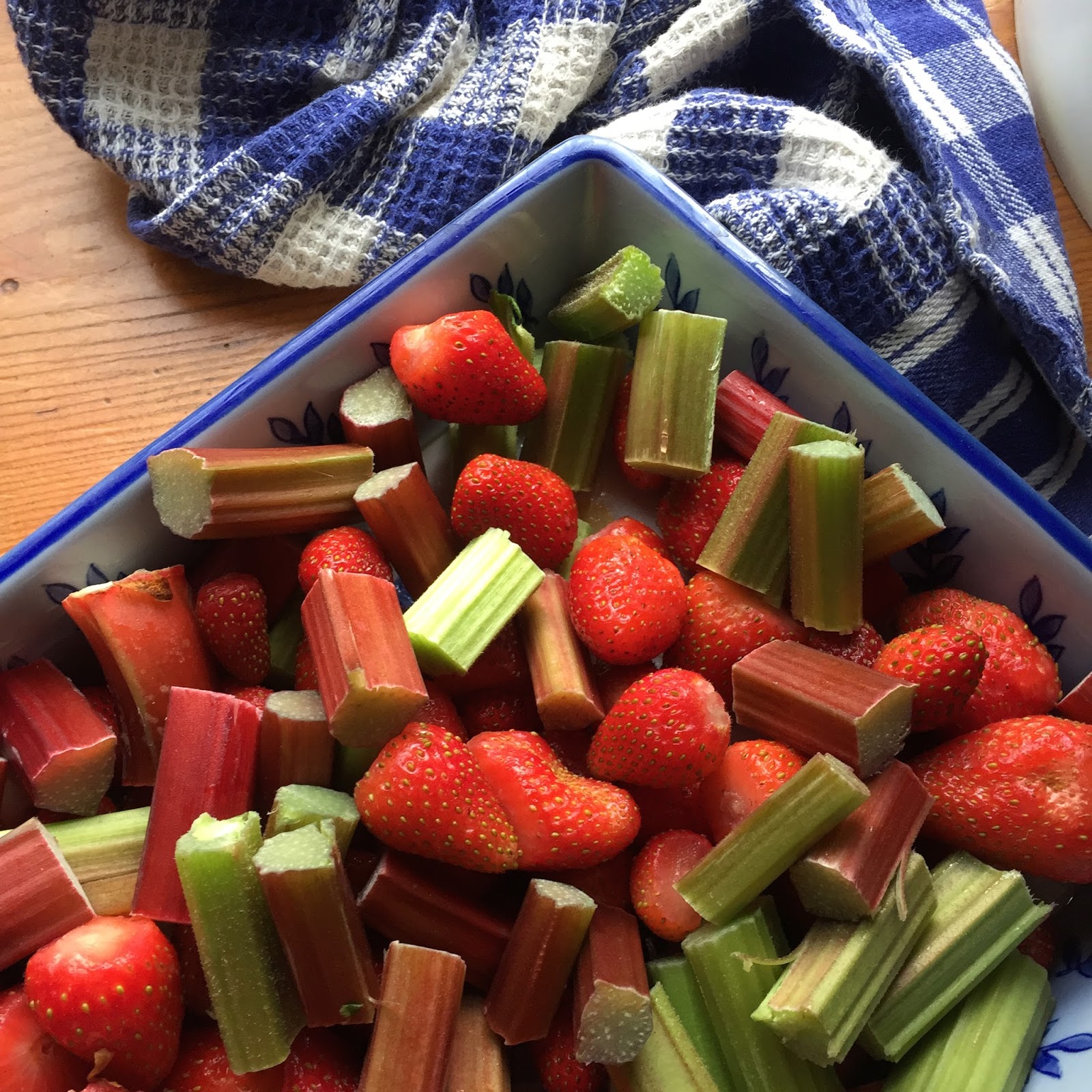
strawberry and rhubarb muffins
homemade strawberry ice cream that was turning into butter baked into muffins


oats topped with fresh strawberries and cream (off the top of the milk)
mieliemeel porridge with honey and some of our own ground heirloom Transkei maize.
strawberry, honey, vanilla and homemade yoghurt smoothies (using Jersey milk)
strawberry, rhubarb, walnut and oat bake (walnuts picked last summer)
eggs and bacon


Lunches:

Egg and bacon spinach salad with curried dressing
leek and cheese pie with coleslaw from the garden
pea and bacon salad
hearty beef and vegetable soup and home baked bread
spinach, asparagus and spring onion frittata with just picked lettuce salad
red wine cured bresaola and salad sandwiches
beetroot hummus with potato salad
beetroot, walnut and cumin salad
toasted cheese and peach chutney
curried carrot soup served with pea flour and maize bread


Suppers:

spinach lasagne where I layered spinach leaves between the mince instead of pasta
grilled spicy homemade sausage with spinach, peas and carrots
slow cooked beef and paprika on mash
braaied pork ribs with BBQ sauce
spinach and bacon pasta
chorizo and pork sausage stew with mung beans, garden veggies and fennel on rice
homemade pizza with bacon and mushrooms (Decadent Dad bought the mushrooms as a Special Night treat)
Spinach pie with wasabi and mustard seed pastry
Roast brisket with gravy, potatoes and veg
Strawberry ice cream for dessert


As you can see we ate really well in October. If you had come for a meal and not known things were tough, you wouldn't have guessed. I am thankful for God's abundant provision for our family in so many ways.

"Use it up,
Wear it out,
Make do,
Or do without"


Friday, January 8, 2016

Lucy's First Fleece - Part 3


A little of Lucy's first fleece was washed and waiting to be spun. I teased out some locks and brushed them into fluffy clouds, called rolags, using my hand carders. The carders are flat brushes covered in bent pins. They separate the fibres in the locks of wool to enable them to be smoothly drafted into wool yarn during spinning. Using the carders took a little practice before I could produce rolags without clashing the pins together in a tooth-jarring, spine-grating way.


The spinning wheel was set up, oiled and ready to run. I had watched countless YouTube videos on the art of spinning. I had practiced winding a ball of cerise pink acrylic yarn onto and off the bobbin successfully. So I sat down at my spinning wheel one evening, palms a little sweaty, ready to begin the real thing. It took a few false starts to get the wool fibres to twist successfully  around a starter piece of yarn wrapped around the bobbin, but then I was off and away, pumping my feet vigorously and watching the fibres twist and wind away from my fingers and onto the bobbin.


Just as I was getting the feel for the process, the wheel ground to a halt and I had to use my right hand  which was supposed to be controlling the twist in the fibre to get it turning in a clockwise direction while my feet pedalled as rhythmically as I could manage. My uncoordinated hands fumbled the fibres a bit until they started spinning again and then the wheel stopped. After trying repeatedly to keep the wheel turning and the yarn forming, my hands moving in rhythm with my feet, I crossly noticed Decadent Dad laughing at me as he watched from the corner of his eye. Red faced and muttering under my breath, I snapped at him while the yarn snapped in my fingers. If this was spinning I hated it and I couldn't do it. It was difficult and tedious and frustrating. What a wasted birthday present and now I was overcommitted with this enormous fleece and all this expectation to do something creative with it!


Decadent Dad, in a moment of pity, investigated the spinning wheel and declared that he could help me, which he did. The following day he ground down the too-tight axle so that it would turn smoothly in its hub, re-oiled the wheel and so I was willing to try again. This time the spinning wheel behaved as the fluff of fleece in my left hand twisted through the fingers of my right hand and wound their way onto the bobbin, forming my first real length of single ply woollen yarn.

 I was ecstatic. The more I tried, the easier it became. I had managed to make the beginning of something looking like wool. It was thick in places and thin in other places, sometime overtwisted, but it was a beautiful continuous strand. This was starting to get exciting. My fickle feelings forgot the previous night's despondency.


I can spin.

Spinning is fun.

I have a whole fleece to spin.

Will I have enough wool to make something lovely?

Lucy is the best sheep in the world.


.... to be continued


Sunday, November 15, 2015

Lucy's First Fleece - Part One

Last month's sheep shearing has spun me head over heels into a new world of neps and noils, niddy noddies, rolags, cards and combs. My mind is all in a twist over the creative possibilities now that I am the delighted owner of a fleece. A rather muddy, thorny fleece from our sheep-pig but a beautiful home-raised fleece nonetheless.

Lucy was a pathetic little baby lamb who spent many hours in my arms and under my jersey
Lucy as a newborn lamb next to the fire

Lucy was one of the dogs before she thought she was a pig

Hope looking on while Lucy gets a bottle
Lucy the Lamb has grown from a tiny desperate orphan into a friendly fat sheep who thinks she is a pig. She follows the pigs as they do what pigs do, grazing alongside them as they snout for tasty roots, lying chewing her cud in the mud as they wallow in it. She bosses them around too, not hesitating to butt Winifred out of the way if the sow happens to be lying in Lucy's path. Once she gave them both a jolly good butting when they were so naughty as to venture out the gate. She has been known to cheekily step off the wall down onto Houdini's back and then onto the lawn.

Lucy and the pigs feasting on damaged fruit


Lucy out walking on the farm with our friends and 5 dogs
Lucy is also the worst thief of the farmyard, regularly testing gates to see if she can sneak into the garden to steal blossoms off berry bushes and foliage from almond saplings.

Lucy on her way to Shearing

Lucy was not as charmed as I was at the prospect of her shearing. My men hoisted her unceremoniously into the back of my car and drove her to the next door farm where the shearers had set up to clip their way through an enormous flock. Lucy waited patiently for her turn.


With a dog collar around her neck she followed us obediently until suddenly she was flipped over onto her back and had to suffer the indignity of baring her belly to the woolly audience.


Once the shearing was over she gulped down mouthfuls of calming grass and then bleated her dismay all the way home. She soon settled down, tethered on the lawn, and grazed the until sunset as if nothing had changed in her world. Fearing a chill I dressed her in a large dog jacket and put her to bed for the night. By morning the jacket was off and Lucy was once again one of the pigs.


 As for me, I finally had my precious fleece. Lucy's first fleece. My daunting fleece. My intimidating fleece. I left it in its bag and went away for the weekend.


... to be continued

Monday, April 13, 2015

Elastic Mom Stretching a Little Further


The last day in April will mark the end of our sixth year on this Free State farm. We have all grown and changed in this environment. Now we are slowly preparing to move back to the Cape in a few months time. The challenge for me, Elastic Mom, is to hold onto the lessons that I have learned, and they are many. I hope to apply some of them, albeit modified, to a completely different coastal lifestyle.

For now, the task at hand is to continue to stretch my resources and keep to my use-it-don’t-lose-it principles, and all the other thrifty tools I have up my sleeve as we wrap up our farm life. Our four dogs and two cats will be the only animals making the move with us.


This week we sold our last two Jersey cows, Hope and Rosie. They went to join Joy at our friends’ farm. It is so hard letting go of my precious girls, but I know they will be loved and well cared for in their new home. This means the end of farmers markets for us for now, as we no longer have copious amounts of cheese and butter. Had I known that we would be leaving, I would have stored up butter and cream rather than selling it in croissants and pannacottas.

We are left with one bullock that was intended for beef; grass fed, organic prime beef at its best. He will be making the trip to the local butcher quite a bit earlier than planned, but will provide us with beef that we can transport frozen and also sell to a few lucky people.

Winifred, our pig is pregnant and we will sell the piglets when they are weaned, rather than raising them ourselves. Sausage, her brother, has lived up to his name. We will sell Winifred and her future mate, the dashing spotty Houdini once the piglets are weaned as well.

Our chickens will likewise be sold off, and some unlucky young roosters will become coq au vin. We have also promised some chickens to our staff.


Lucy Lamb is going to live with my vegetarian friend where I know she will be safe and loved along with the three other hanslammetjie sheep that already live there. Once her fleece is long enough, it will be shorn and kept for me so that I can spin it.

Meals will be planned around the fresh produce and open jars in the fridge. The last of the harvest in our bountiful vegetable tunnel will be picked before the frost and cooked fresh rather than pickled or frozen for winter. I will dry surplus tomatoes rather than freeze them. There is not all that much left in the tunnel. I won’t plant out the seedlings that I had planned for our winter garden. Once all the fresh produce is used up I will focus on cooking from the contents of our freezer. Jams, pickles and preserves can travel with us to our new destination so I probably won’t open any new jars.


My head is spinning a little with new tasks and a change of focus, but I am confident that we can do this hard thing.

Thursday, March 12, 2015

I Won! I Won!

I came to live on this farm, all green. We inherited a mesh-covered tunnel rich with vegetables, a cow and her calf and four chickens. This change, this choice required my change. I researched and studied, sowed and reaped, learned and failed, harvested and built compost. Instead of contributing to our income, I minimised our expenditure. The more I grew, the more we grew, the less we spent.

Three years later and our success in self-sufficiency shows at supper. Each night as we sit holding hands, grateful for the blessing before us, we wonder at the home raised goodness before us.

A walk in the tunnel and our failure in self-sufficiency shows on the leaves. I abdicated as general in the war against invaders as the heat waves of summer combined with faulty pumps and leaking lines defeated us in our daily skirmishes. My ignorance in organic matters mocks in small pickings.

I recognise my need for guidance. Today such an advisor arrived in the form of a book. A prize. A weapon. No, a tactical manual. A manual of things green written for green people. Like me.

Green is the colour of hope, new beginnings, life.

As this season of summer cools into autumn, I am thankful, hopeful and even excited for the new seasons of promise yet to come. A surprise, a prize has given me hope, stirred my imagination and encouraged me to discard the white flag of surrender and march forward boldly with muddy boots, sandy hands and my pockets full of seeds.

Thank you Livingseeds for the awesome prize. I promise to use it well.


Sunday, August 3, 2014

A Late Winter Morning

It's early Sunday morning. Kariba, my red-brown Rhodesian Ridgeback stirs in her bed. The moment she sees me open my eyes she begins to whine quietly, asking to go outside.
"Do you want to go outside? I ask her.
Immediately she sits up smartly in her bed and wags her tail, her eyes never leaving mine. I throw back the puffy bedcovers and swing my sock-clad feet onto the wooden floor, trying not to creak the old floorboards as I put on my slippers and dressing gown and head towards the kitchen. Tag, the fat Jack Russel joins us. Kariba and Tag politely sit while I unlock the back door. The instant it is open a crack, our two male Ridgebacks barge into the kitchen, pushing and shoving Kariba back inside. I open the door wide and call them all outside so that, in their exuberance, they don't wake Grant. It is quite common for him to receive slobbery kisses from three of our four dogs while he is still trying to sleep. The click-clacking of their toenails on the floor is enough to disturb any pleasant dreams.

The sun has just risen and there is no frost on the bleached lawn. It is cool, but warm enough for me to wander outside, enjoying the dogs' romping in the morning light. I walk into the chicken yard and up the slope, towards the henhouse. On my way I startle our two piglets who are stealing the remains of the grain thrown down for the chickens last night. They run towards me, grunting and squealing, expecting me to give them breakfast, but I see that they still haven't finished their dinner last night. We had mixed it with water instead of the usual whey, as I hadn't made any cheese yesterday. The piglets would rather snout around and root up the grass that I am coaxing to grow in the chicken yard, than eat their leftover dinner.

There is a lot of jostling and clucking coming from the white henhouse as the chickens crowd around the wire gate waiting to be let out for the day. Arrietty and Homily do not budge from their nests as the rest of the flock pour out into the morning. Arrietty, a pretty young hen dotted in shades of white, black and orange, is sitting on six eggs. They should hatch any day now. She warns me with a throaty high pitched warble as I reach my hand under her, but doesn't peck me. There are no signs of cracks on the warm pink-brown eggs, nor do I hear any tiny peeps from beneath her feathers. I leave brown and black speckled Homily alone. The last time I looked she was sitting in the nesting box, all broody with nothing beneath her. A little later on, when I am collecting the morning's eggs, I will check whether she has laid any. If not I will give her all the eggs for the next three days. I was hoping for eggs for breakfast this morning, but yesterday we only found one. There is some chervil growing in a pot on our kitchen windowsill and I have a craving for a cheesy chervil omelette.  Oh well, it will have to be muesli instead.

I turn the lever for the chicken's water trough and make my way out the henhouse yard, past the piglets in the large chicken yard, out the gate and into the vegetable tunnel. The piglets look up with brown, sandy snouts and then turn their backs, ignoring me, and continue digging up the grass. There is not much growing in the tunnel besides cabbages. Most of the beds are resting, covered in a dry grass mulch, waiting for the frosty winter to pass. I turn the round red tap next to the spindly leeks at the top of the tunnel and water gushes into the chicken trough. I have closed the chickens into their smaller henhouse yard to encourage the hens to think about laying their eggs in the henhouse. There is enough uneaten grain in there to keep them busy. I stand at the fence that separates the henhouse yard from the veggie tunnel, watching the social interaction between the chickens. The two young charcoal coloured roosters crow again and again and stretch their proud wings. I notice that when I throw some cabbage leaves over the fence, they do not dare join the fray in fear of the old patriarch, Mr Montgomery. Our sole winter chick, a still peeping grey hen-chick scuttles after her little grey mother, Mary Thompson. Old Mrs Montgomery and Peg, with her gammy leg, have faded combs and I am sure that they have stopped laying for good. They leave that job to the young hens. We have fifteen chickens now.

I pull up two baby turnips on my way out the tunnel and once back in the big chicken yard, I call the piglets over. They rush towards me and are each rewarded with a turnip. Back in the henhouse yard, I turn the valve again to shut off the water to the chicken trough that has been overflowing and running down the slope while I was watching the flock. There is a sudden spray of water hitting plastic as the irrigation line along the back of the tunnel fills and sprays up onto the plastic and drips back down on the slow-growing leeks. It has been too long since I made leek pie. By now fat leeks should have been replaced with broad beans in that bed. We were slow in planting them last summer and they did not have a chance to strengthen before the icy weather came.

The disgruntled chickens stand at the gate as I leave them shut in the smaller yard. The piglets, seeing me back in their space, run behind me, nibbling at my furry slippered heels. It is very cute, but a slight anxiety grips me as I walk quickly away from them, and one piglet  runs faster, keeping up with my heels. They haven't bitten yet, but I believe that pigs can bite. I distract them by running water into an empty container and slip out the gate and back inside. Kariba follows me in and settles back into her bed, and so do I. Grant is just waking and greets me with a sleepy hello.


Friday, December 13, 2013

Come and Take a Tour Through our Tunnel

We are blessed with a net and plastic covered tunnel where we grow most of our vegetables. Being very green at gardening when we moved here, and not at all in the green-fingered way, I turned to the advice of some wiser and more experienced gardeners as I plotted and planned the planting of the tunnel. At the beginning of almost every month I consult John Seymour's Self-sufficient Gardener, Jane's Delicious Garden by Jane Griffiths, and the wonderful online Jane's Delicious Garden Planner where I have our whole tunnel planned outOver the last two years these guides have helped me to create a system that works for me. I say 'me' because I am the planner and the rest of my family lend a hand with the digging, picking and planting. We also have the Marvellous Molly who helps us in the garden and with the care of our animals. 

Our tunnel is divided into 6 main sections. This is to enable me to practice crop rotation to prevent a build up of pests and diseases... Perennials, Potatoes, Legumes, Mixed Veg, Roots and The Rabble. Leeks and Brassicas squeeze in between the rotations. 

As we walk in the gate we are greeted by the perennials. I like these on the edges of the garden so that they do not interfere with the bed rotation. Next to the bench there is a row of rhubarb which we transplanted from the centre of the tunnel. The rhubarb enjoy their new position where there used to be a compost heap. I also planted a few stray potatoes under the bench rather than throw them away. 


The first row of beds consists mainly of strawberries, the 100m sprinters of the garden that produce madly in October and fizzle out quickly and rest for most of the year. They take up a lot of space, but I wouldn't lose them for anything. At the end of the row we have strawberry popcorn which looks very happy.  We also have a seed bed in this row, hiding between the maize and strawberries, as it is near the tap for easy watering. I have a few Romanesco Cauliflower and Sicilian Violet Cauliflower seedlings just coming up there now. The broccoli seeds didn't germinate. I am hoping to sow a whole lot more brassica seeds this weekend. 


Now, let's take a walk to the opposite end of the tunnel, the very top. This is where our gardening year which runs from June to July, starts with the heavy Winter mucking of the beds to prepare them for POTATOES. We bring in barrow-loads of manure-rich compost. The potatoes are currently under plastic which is unnecessary but that's just the way it worked out. We have three beds of Mondial potatoes which I grew from a bag from the grocery store. Then we have one bed of heirloom BP1 potatoes which have pretty purple flowers. There is also an experimental bed of sweet potatoes. 


The chicken run with a large compost heap is behind the tunnel, and I have lined the fence with some raspberry bushes. Raspberries and potatoes are bad companions, according to Margaret Roberts, so I planted a few tansy plants to separate the two. The tansy leaves are said to be wonderful insect deterrents. 


The potatoes are not ready yet, but a little grabbling has revealed some promising beauties. As the potatoes are harvested some of their their beds will be planted up with LEEKS to see us through the Winter months. The rest will be covered in a green manure that we can also use for chicken greens, like oat grass and lucerne. I left a few of last Winter's leeks to go to seed. Their purple pompom heads are so pretty.  They are back down in the bottom row of beds next to the strawberries where last season's potatoes were. The rest of the leeks have already been succeeded by beans. 


The beds are treated with a little lime, wood ash and compost after the leeks to prepare them for the LEGUME family of plants. Broad beans go in first in Autumn, followed by mange tout peas. The broad beans have developed the dreaded chocolate spot, but I am leaving them in a little longer so that I can harvest the last of their pods. We dug in the early-planting, depleted mange touts yesterday.  They will feed the soil for the brassica seedlings that will follow. There is also a row of oak leaf lettuce that is very happy in the pea bed. 


Further along the legume beds we have sown Spring seeds for all sorts of beans, and a few amongst the strawberry popcorn. We have dried beans plants: Cannellini, Spanish Black, Adzuki and Christmas Lima.  Then we have french beans: Yellow Dwarf, Roquefort and Star 2000. There are also runner beans: Scarlet Runner, Chinese Noodle, Kentucky Wonder and Lazy Housewife. Some have germinated well and others have only given me a few plants from a whole packet of seeds. I hope to collect plenty of newly dried seeds for next year. Here and there I have sown seeds of the beans' friends, Giant Marigolds. I did a later planting of mange touts so we could keep enjoying them for a little longer. They are not producing all that much at present. I am hoping for a new flush of peas. Mmm, looking at these pics, I can see I need to mulch the legumes. I tend to leave the clover to do its thing. 


At the end of Summer, all the legumes will have been replaced by our Winter BRASSICAS. We had a big problem with beetle and caterpillar damage last season, so I'll have to find a way around that. I think we have two moth-eaten cabbages and one very sad brussels sprout plant left. Before and after the brassicas the beds were very well composted. This next row is my MISCELLANEOUS row of beds. Here we have tomatoes, brinjal, loofah, cucumbers, gem squash, courgettes and peppers. In between this glorious chaos we have California Poppies, too many weeds, and a bed of asparagus that are sending up their feathery fronds as they prepare to rest for the year. I would prefer the asparagus to be on the edges of the tunnel along with the other perennials, but that project can wait for another year. 


We have planted more varieties of tomatoes than I care to count, although careful record is kept of the position of each type. They are flanked with borage flowers to attract bees, and basil to deter pests. Here and there are some butter lettuces too. All the old heirloom lettuce seeds have gone on strike, refusing to give me the smallest leaf of hope, no matter whether sown in seed trays or directly. I think the seeds were just too old. 


These nasturtiums are an excellent trap crop, keeping the slugs off the green peppers and cucumbers. I have ineffectively sown cornflowers alongside the tomatoes too. The seeds are lying dormant in the soil. Maybe there's still hope.


Last season's Mixed Veg beds were followed by the ROOT family. Carrots and parsnips don't like manure-rich compost, so they merrily succeed the hungry tomatoes and co. We have a crosswise bed of Crimson Globe beets, Paris Market Carrots and Matador Spinach. I like to make the most of the growing season, so I have already started planting seedlings from the onion family into the gaps as I harvest the roots. 

I love the beauty of the heirloom veggies. The Paris Market carrot is round like a beet, and the colour of the Chioggia beet is striking. 


Towards the back of the root section I have three more long beds. There are celeriac, Purple Dragon carrots, Chantenay Karoo carrots, Detroit Dark Red beets, Chioggia beets and parsnips. There's also a too tall celery that is taking forever to go to seed. The black salsify disappointed for the second year in a row. I had to sow the carrots and parsnips twice, as the first sowing dried out. We solved the problem  at the second sowing with sacks over the beds until they germinated. Now I am behind my planned schedule, as I need those beds for onions. We have already harvested and eaten one bed of red onions and the brown onions are almost ready. I didn't allow enough space for onions, and they are such a staple for us. 


The onion bed off to the side of the tunnel will be sown with more beets. There is also a bed of Swiss Chard at the side of the tunnel. We added these side beds to enlarge the garden so that I don't have to buy veggies for most of the year. We live off what we grow and if the crop fails, then we eat whatever else there is. I did succumb and buy my first bag of onions this year though. 

Alongside the plastic section of the tunnel, fenced but not covered, we have an array of RABBLE veggies that wouldn't fit anywhere else. I followed the Native American idea of planting Scarlet Runner Beans with Black Aztec Maize and Atlantic Giant pumpkins. The beans are outgrowing the corn which they are supposed to hold onto. I can't use the fence for support either, or the cows will eat them. We have another huge bed of sprawling Flat White pumpkins. There are some watermelons, more gem squash and I have sown seeds for Transkei Flint corn. I offset the maize sowings by at least two weeks so that they don't cross pollinate in the wind. 


Well, that's the tunnel. But then I had some precious heirloom potatoes left, so we planted them in sacks under the kitchen window.  It's been fun raising the sides of the sacks as they grow. 


Last, not least, nor in the tunnel, but very exciting for me, we have planted berries along the back fence next to the herb wheel and strawberry spiral. There are blackberries, youngberries, gooseberries, raspberries, red currants and black currants. I just need to figure out how to keep them from the birds. 


If you have made it this far and read to the end of this very long post, then I admire your perseverance. I wrote this post mainly as a record to help me for future planning. I love looking back and seeing the progress in the garden. Even the change over the past two months has been astounding.